How a $499 Set Changed Everything
How a $499 Set Changed Everything
The obsession didn’t start with a plan. It started with a box.
On how a childhood hobby, a retirement article, and a 1999 diorama that almost no one has ever seen turned into the most complete LEGO Star Wars collection ever assembled.
I grew up building LEGO. Space theme, mostly — Galaxy Explorer was the set. I built everything I could get my hands on, took it apart, built something else. I didn’t keep the boxes. I didn’t keep the instructions. It was the 1970s and nobody thought of LEGO as something you preserved.
Then came the Dark Years. Late teens, twenties — the bricks went in a box in the attic and stayed there. That’s the story for most collectors of a certain age. Life gets in the way.
I came back to LEGO in my thirties, the way a lot of people do: through kids. My children were old enough to build and Star Wars was the theme that united us. We built sets together. We spread pieces across the dining room table on weekend mornings. And in 2008, we built the original UCS Millennium Falcon — set 10179, 5,195 pieces, the biggest consumer LEGO set ever produced at the time. It took weeks. It was one of the best things I have ever done with my kids.
A few years later, I read an article about how much that set had appreciated since it was retired. The Millennium Falcon we built together — the one sitting on a shelf in my house — was worth several times what I had paid for it. I went looking for more information about LEGO as an investment and fell into a rabbit hole I have never fully climbed out of.
The Logic of Two
The first decision that changed everything was simple: I started buying two of every set. One to build. One to keep sealed.
The reasoning was straightforward at the time. I wanted to be able to say I had built every LEGO Star Wars set ever made. I also wanted sealed examples of everything for the collection. Two copies solved both problems. It seemed rational. It was also, in retrospect, the moment the obsession began in earnest — because buying two of everything means you are paying attention to everything, and paying attention to everything means you start noticing things.
I started noticing the inserts inside the sets — the instructions, the catalogs, the promotional flyers tucked under the part bags. Historically interesting artifacts that most people threw away without a second thought. I started collecting those. Then the publications that referenced the sets — LEGO Club Magazine, the Shop at Home catalogs, the books. Then the gear: the keychains, the watches, the items with exclusive minifigures that didn’t come in any set. Each opened box revealed another branch of the collection I hadn’t known existed. Each branch led to three more.
The minifigures followed naturally. When you are opening sets, you accumulate figures. When you accumulate figures, you start thinking about which ones are missing. When you start thinking about which ones are missing, you start hunting. I decided I wanted every LEGO Star Wars minifigure ever produced. That goal, once set, does not leave you alone.
The First Real Hunt
The UCS sets were the entry point for serious collecting. A defined line with a start and an end — or so it seemed. Complete the UCS line and you have something coherent, something defensible. I worked through it systematically, filling gaps, tracking down retired sets, paying secondary market prices for the ones that had been gone for years.
While hunting UCS sets, I started running into something else: promotional items. Sets and items that had never been sold in stores, distributed only at specific events or through specific channels, produced in limited quantities that were sometimes in the hundreds. They were barely documented anywhere. You would find a reference in a forum post from 2002, a blurry photo on a collector’s personal site, a thread on Rebelscum where someone was asking if anyone else had ever seen one. The information was scattered, incomplete, and often contradictory.
The first one that truly stopped me was the 1999 New York Toy Fair Promotional Diorama. A brick-built scene featuring Luke Skywalker and Darth Vader, housed in a display box with a hinged front flap, mailed to toy industry professionals weeks before the 1999 Toy Fair opened. Produced for a single event in the first year LEGO Star Wars existed. Almost no documentation anywhere. I had to have one.
Finding it took time. Buying it took more money than I am going to put in print. Holding it for the first time — a piece of LEGO Star Wars history from the very beginning of the line, something most collectors had never seen in person — was the moment I understood what this kind of collecting actually was. It was not about owning things. It was about finding things that were genuinely lost and bringing them back into the record.
The Obsession Compounds
After the 1999 Toy Fair diorama, the scope of what I was collecting expanded rapidly. SDCC exclusives. New York Toy Fair sets. Star Wars Celebration items. Each event had its own history, its own set of items, its own gaps in the documentation. I started building out a catalog of everything that existed — not just what I owned, but what was out there to be found.
Some of the finds were straightforward. Some required patience measured in years. The Yoda Lucas Fountain — a life-size brick-built Yoda holding a lightsaber, created as a promotional display and given as a prize — took serious hunting. The LEGO employee Christmas X-Wing — an internal items given to LEGO staff, never meant for the public — took longer. The Gonk Droid Puzzle. The Hoth Xbox Controller Stand. Each one its own story. Each one requiring a different combination of research, timing, and willingness to write a check that would make a reasonable person wince.
The seven sites helped. BrickLink for pricing and provenance. Brickset for the catalog foundation. Rebelscum forums for documentation that existed nowhere else. The community of collectors who had been at this longer than me, who knew things that had never been written down anywhere. You learn who the serious collectors are. You learn who has what. You learn that the people who own the rarest items are usually generous with information, even if the items themselves are not for sale.
Why BringMeSolo
The information problem never went away. The more I collected, the more I understood how much documentation was missing — not just hard to find, but genuinely absent. Items that existed only as rumors until someone actually showed up with one. Items where the only reference was a single photograph from 2001 with no context. Items where even dedicated collectors disagreed about basic facts like production quantities, distribution channels, and what was actually inside the box.
BringMeSolo exists to fix that. Every article on this site is firsthand documentation — I own the item, I have opened it or examined it directly, I have cross-referenced every claim I can cross-reference and flagged everything I cannot verify. The goal is not to show off the collection. The goal is to create the record that should exist and doesn’t.
This collection currently spans over 1,100 items across 26 years of LEGO Star Wars — every UCS set, hundreds of promotional exclusives, event items, gear, publications, and things that exist in quantities small enough that finding them required years of active hunting. Some of them I am fairly confident no one else has documented in this level of detail anywhere on the internet.
It started with a $499 Millennium Falcon and a weekend morning with my kids. It turned into something considerably larger than that. I have no plans to stop.
That said — the collection has edges, and keeping those edges is a deliberate choice. I own LEGO sets outside of Star Wars. Friends sets my kids wanted to build. Hogwarts. A Sesame Street set because I grew up watching it. A handful of BrickLink Designer Series sets that I almost talked myself into completing before catching myself in time. I made a decision early on that Star Wars was the universe and everything else was just LEGO. Without that line, I would need a warehouse. Possibly two.
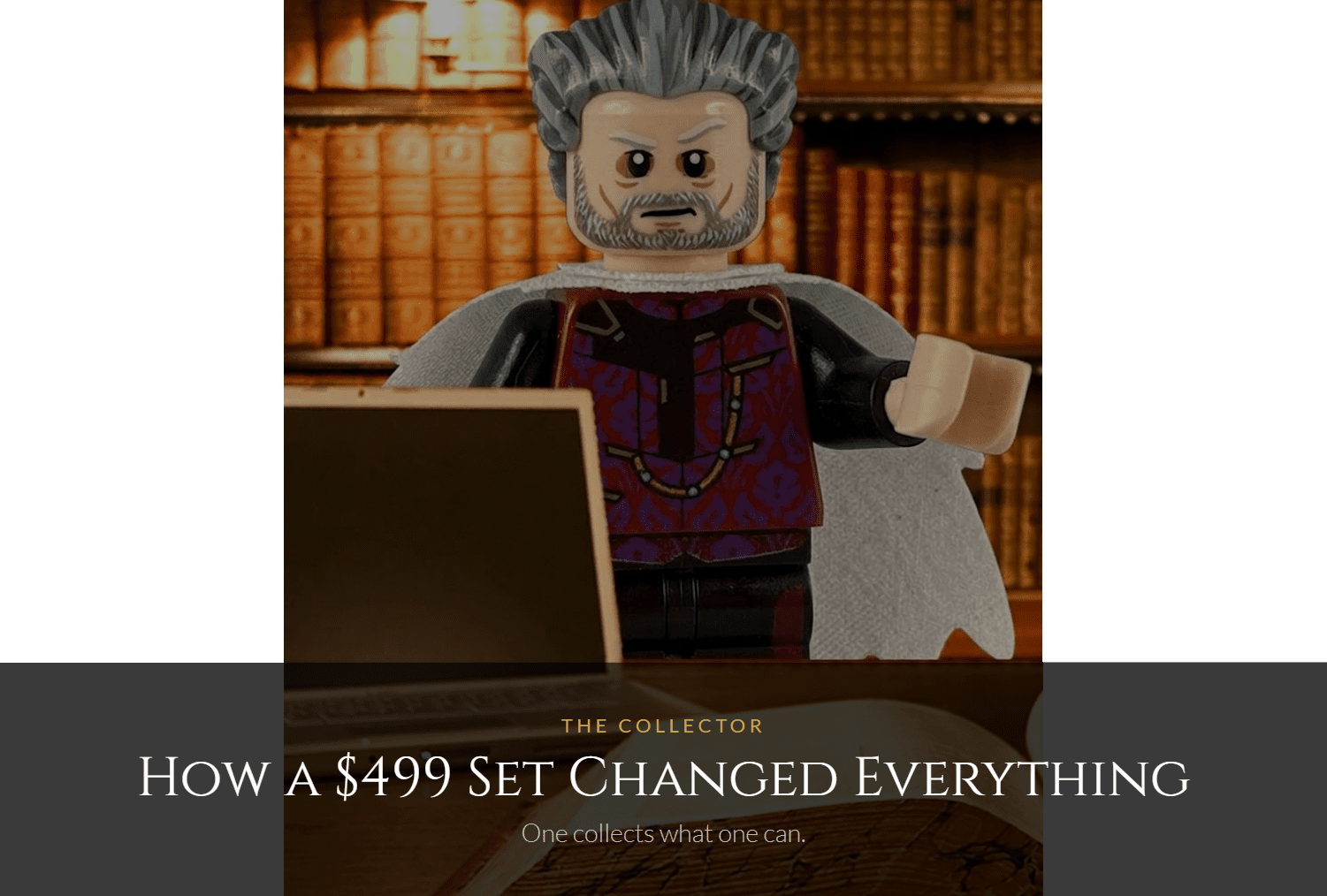
One more thing. The persona on this site — The Collector — came naturally. A collector who documents rare items that most people have never seen, who hunts across the known universe for things that barely exist. It fit. The name stuck. Then, while building this site, I stumbled across a LEGO minifigure on eBay: The Collector from Guardians of the Galaxy, released as a San Diego Comic-Con exclusive in 2014. White hair, elaborate robes, scroll in hand, the kind of expression that says he has seen things most people have not and intends to keep them. I am 53, gray-haired, bearded, and in possession of over 1,100 items that most people have never seen in person. The image on this site is an AI-modified version of that minifig, adjusted to match my gray hair and beard rather than the character’s white. Some things are just destiny.
In the film, The Collector’s motto is simple: one collects what one can. I have taken this perhaps more literally than intended.
The Collector is Matt, the curator of BringMeSolo. He has been collecting LEGO Star Wars since 2008 and has never successfully explained to anyone outside the hobby why this is a reasonable use of time and money. He has stopped trying.