The 1999 Target Yoda
A Brick-Built Prize Nobody Knew to Keep
859 contest winners. One of the most under documented promotional items in LEGO Star Wars history.
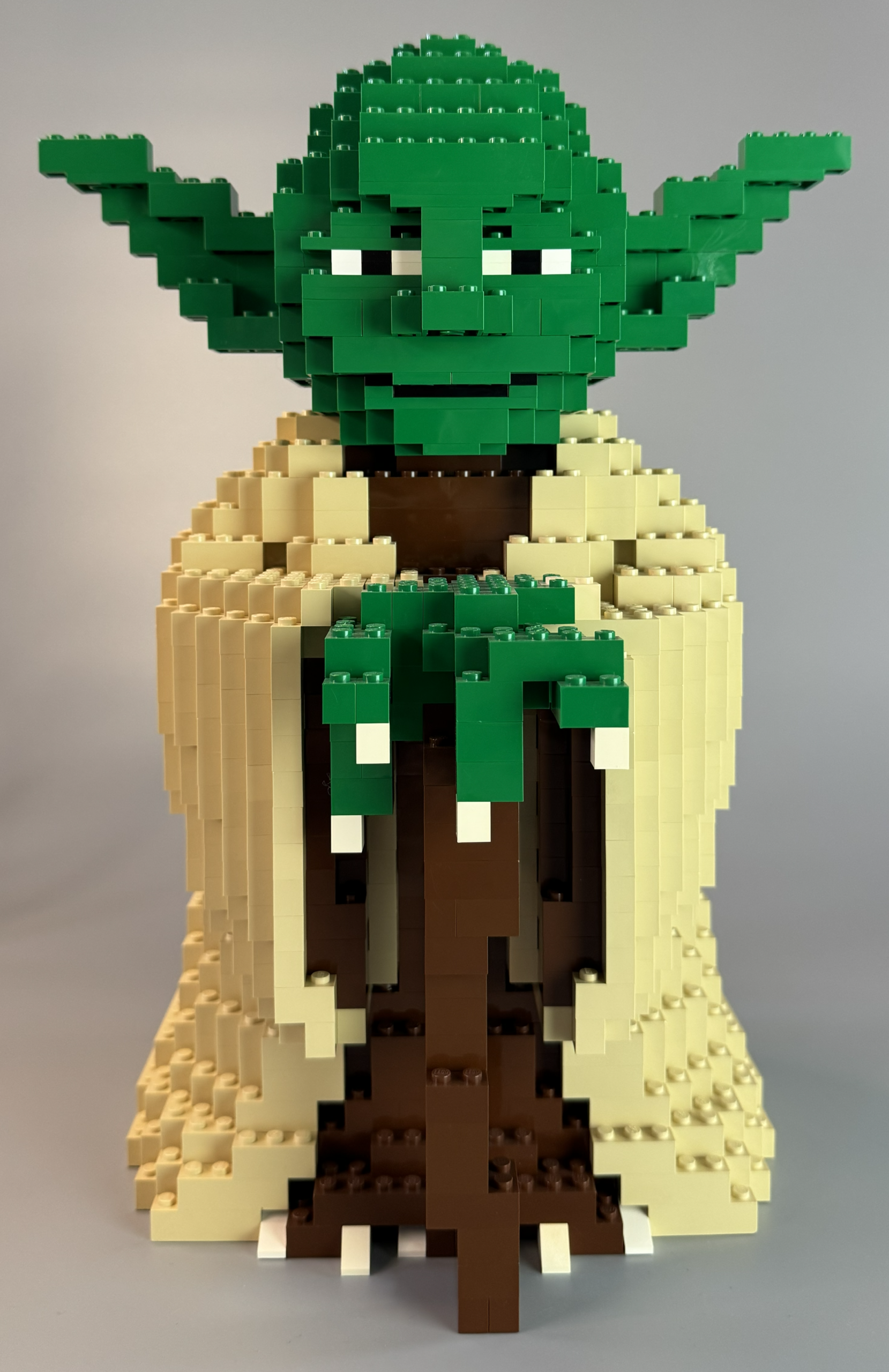
In the summer of 1999, if you walked into a Target store, you might have noticed something unusual — a 14-inch brick-built Yoda statue, green and grinning, enclosed in a plastic display printed with the Star Wars logo. This was not for sale. It was the prize.
The Contest
In July 1999, Pepsi and Frito-Lay partnered with Target stores on a Guess-and-Win promotion tied to the Star Wars Episode I mania that had gripped the country since the Phantom Menace hit theaters that May. The mechanic was simple: guess the exact number of LEGO bricks used to build the Yoda statue on display, fill out an entry form from the side of the display, and drop it in the slot. The contest ran from July 11 to July 24, 1999 — though the official rules on the entry form reference a date of 7/28/99, suggesting either a later entry deadline or a discrepancy between the promotional advertising and the legal sweepstakes rules.
The contest ad described the prize as a “permanently assembled, special edition Yoda” and gave it an average retail value of $185. The total declared prize pool was $158,915 — which, divided by $185, implies exactly 859 Yoda statues were available as prizes. This is not a rumor or an estimate. It is math derived directly from the contest’s own advertising. The ad itself read:
“Register to win Yoda, only at Target! Guess the number of LEGO bricks required to build the 14″ tall Yoda figure shown, and you could win a permanently assembled, special edition Yoda. Look for the Pepsi/Frito-Lay display in your local Target store.”
The entry form instructed contestants to “hand print, on the official entry card, your name, address, phone [number and the] total number of LEGO bricks used to build the Yoda character on [display and] deposit it in the [entry slot on the] display.” The form also confirmed: “No Purchase Necessary” — this was a sweepstakes open to legal U.S. residents.
The Display
The display unit itself is a remarkable artifact in its own right. While it was not originally intended to leave the store, many contest winners received the complete display along with the statue — making the display a legitimate part of the collectible package rather than a purely institutional artifact. A complete example consisting of the statue, plastic display, and full display unit is what serious collectors should be looking for.
The display is a modular construction made up of multiple separate interlocking cardboard boxes. The base is a light blue-gray cardboard unit with tabs on the back that anchor the central background panel. That background panel is printed black on both sides, with an image of the right side of Yoda’s face from the neck up centered on the front face. A square hole in the center of the base held a plain cardboard rectangular box that extended upward into the base of the Yoda statue — a hidden internal support column that held the statue in place without any external attachment.
Two side boxes — left and right — slot into tabs on the top and base to complete the display structure. The left box carries the Pepsi, Frito-Lay, and Target logos on the front of the box and the contest text on the left side of the box. The right box repeats the contest text in slightly larger type on its front face, then on its right side carries the entry mechanics — the “Guess and Win!” header, the contest rules in smaller text, and the “Enter Here” entry slot where contestants deposited their forms.
The contest text reads:
Guess and Win!
Correctly guess the number of bricks and enter for a chance to win this Yoda!
No purchase necessary. See entry form on side of display for official rules.
The top unit mirrors the base construction but carries one additional detail: the Star Wars logo printed in white outline on both sides.
The Yoda statue itself sat loose on the display base — not attached or secured beyond the internal cardboard support column — enclosed in a clear plastic enclosure printed with the Star Wars logo in white outline across the lower section. This enclosure served as both protection and presentation for the prize.
The Statue
The Yoda statue was built and permanently glued by LEGO master builders. It stands 14 inches tall and was constructed using standard green LEGO bricks — an important detail that distinguishes it from later LEGO Yoda builds. The 2002 Ultimate Collector Series Yoda (set 7194) used sand green bricks, a color that didn’t exist in 1999. This statue predates sand green entirely, making it a distinct and historically significant build that is not simply an early version of the UCS model but a completely different interpretation of the character.
The piece count has never been officially confirmed, but forum references suggest a figure in the range of 850 to 860 bricks, with at least one collector reporting exactly 859. If that figure is correct, it raises a remarkable possibility: the winning answer to the contest was hiding in plain sight in the prize pool math all along. $158,915 divided by $185 equals exactly 859 — meaning anyone who thought to do that arithmetic before submitting their entry had a significant advantage. We will have a definitive piece count once we have completed our own reverse engineering of the statue, and will update this article accordingly.
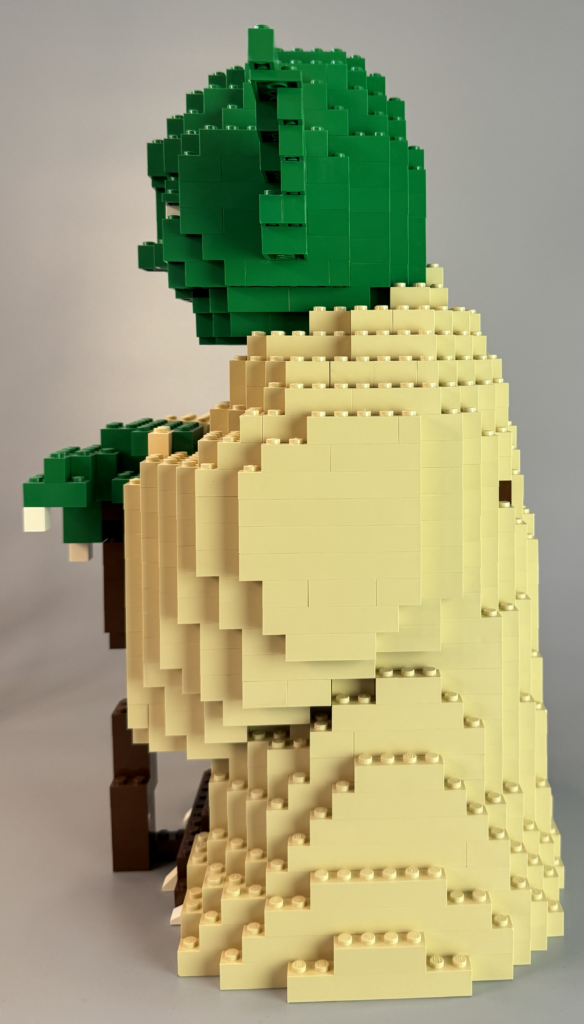
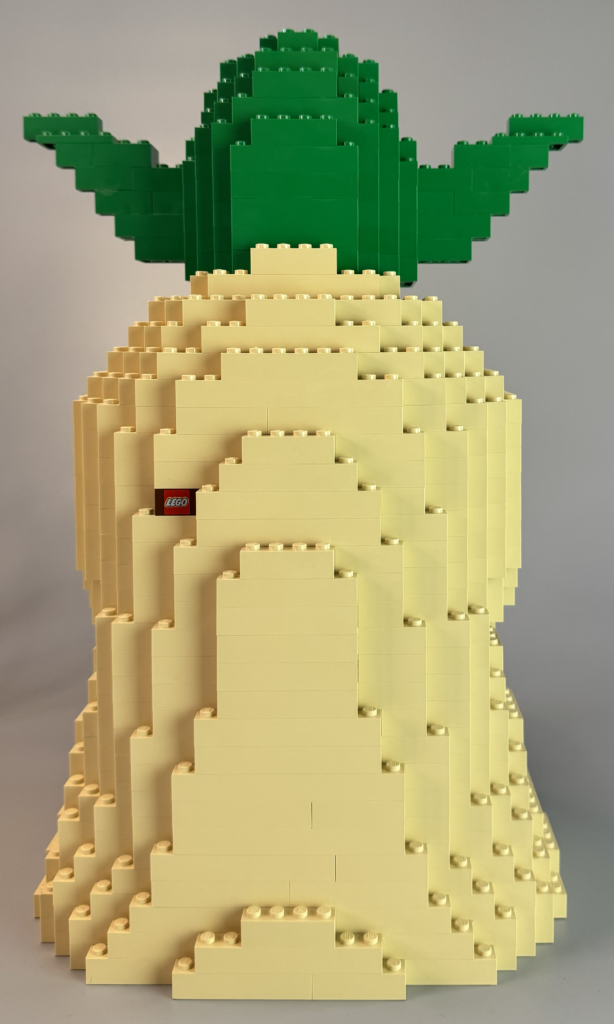
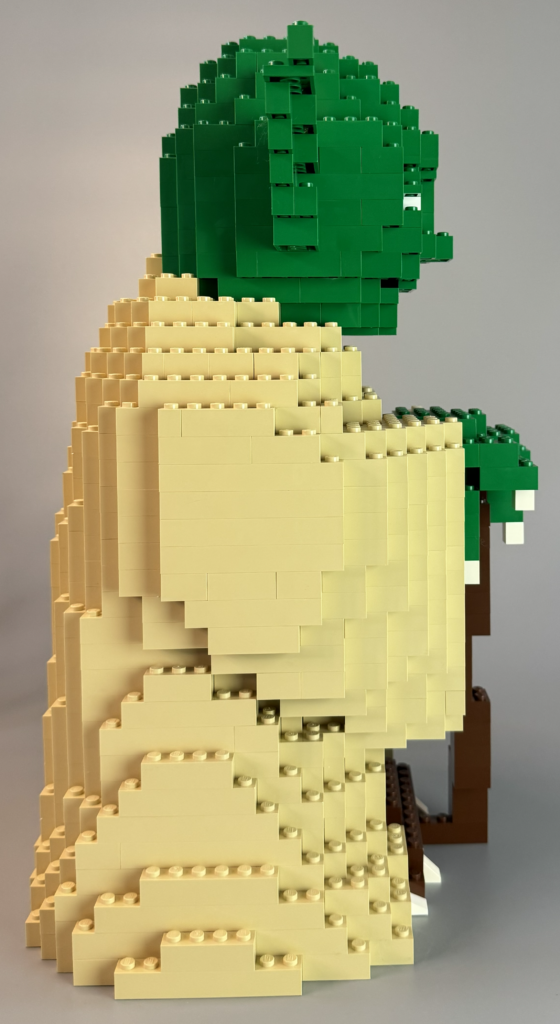
The statue also contains a 1×2 dark gray brick printed with a red LEGO logo (BrickLink part 3004px8) — the same piece found in the 2001 Darth Vader UCS set and the 2002 Yoda UCS set (along with 2 other non-Star Wars sets — 4024 Advent Calendar 2003 and 4411 Blue Strata XXL). The presence of this brick across multiple 1999–2002 promotional items and sets suggests it was a deliberate signature element used by LEGO master builders during this era.
How Many Exist?
The contest math gives us 859 prize units. Many winners received the complete display along with the statue, which means the display survival rate may be similar to that of the statue itself — though collector awareness of the display as a separate collectible artifact is much lower.
The most likely scenario is that the display Yoda was the actual prize — removed from the display at the end of the contest period and handed to the winner along with the display itself. The internal cardboard support column is consistent with this: it held the statue in place during the contest but would have been removed along with the statue when the prize was claimed. If that is correct, there are no separate “display units” distinct from the prize units — just 859 contest prizes, many of which included the full display, some of which have survived and some of which have not.
This makes the 1,200–1,500 figure sometimes cited in collector discussions unlikely. The total population is probably closer to 859, minus whatever percentage has been lost, damaged, or discarded in the 27 years since the contest ended.
A Warning to Buyers
This is not a complex build. It uses standard green LEGO bricks that have been widely available since 1999. The gluing, while permanent, is not difficult to replicate. Any serious buyer should investigate the provenance of an example before purchasing — ideally tracing it to a specific contest winner or Target store or finding a statue with the display case. Examples with documented provenance are significantly more trustworthy than those without. The presence of the 1×2 dark gray LEGO logo brick (3004px8) is one authentic detail to look for, though it could theoretically be added to a fake build.
What We Don’t Know
- The exact piece count — forum references suggest 859 but this has not been officially confirmed. We will update this article with a definitive count once our reverse engineering is complete. Does anyone have a winner’s notification letter or contest resolution announcement that states the correct answer?
- The July 24 vs July 28 discrepancy — the promotional ad cited July 24 as the end date while the entry form references July 28. Which was the actual deadline?
- The exact in-store placement — the contest ad instructs customers to “look for the Pepsi/Frito-Lay display,” suggesting the display was in the snack aisle. However, a 14-inch Yoda statue would have generated far more excitement in the toy section where Star Wars fans would actually see it, and retailers frequently placed promotional displays wherever they’d get the most engagement. It’s possible the display appeared in both locations, or that placement varied by store. If you remember seeing one in a Target in July 1999 and recall where in the store it was, we’d love to know.
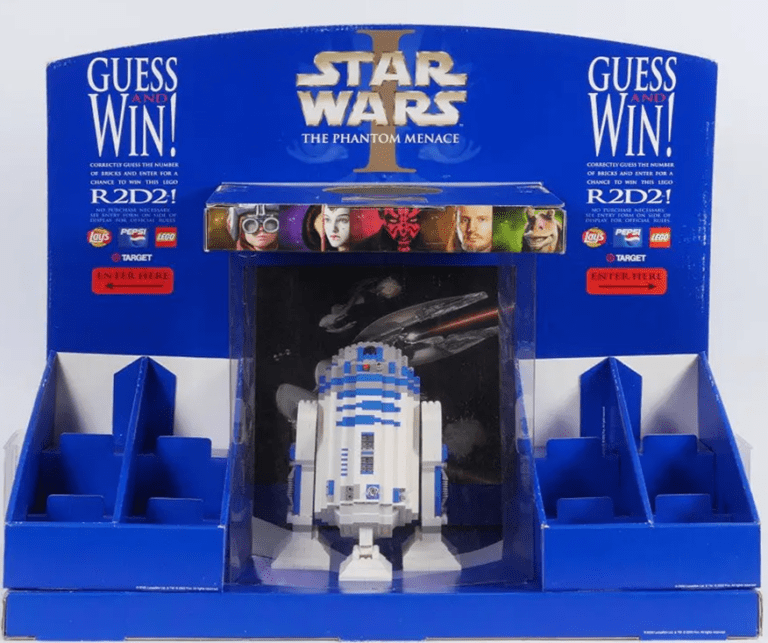
- The companion R2-D2 — a companion brick-built R2-D2 statue from the same 1999 Target / Frito-Lay promotional campaign is documented separately on this site. Were the two contests run simultaneously in the same stores, or at different times and locations?
If you have firsthand information about this contest — if you won one, if you worked at a Target store in July 1999, or if you have any original contest materials — we want to hear from you.
1999 Target / Pepsi / Frito-Lay Yoda Guess-and-Win Contest Prize
Produced: 1999
Distribution: Target stores, contest prize
Quantity: ~859
BrickLink: yoda