How to Think About Value in a LEGO Star Wars Collection
Most value guides tell you what something is worth. This one tells you what that actually means.
On the difference between market value and collector value, where to find reliable numbers, and how to think about this if you are not buying with an unlimited budget.
The most common question in LEGO collecting is some version of: what is this worth? It sounds like a simple question. It is not.
There are actually two different questions buried in that one. The first is what the market says something is worth — the price at which informed buyers and sellers have historically agreed to transact. The second is what you are willing to pay to own it. Those numbers are often very different, and conflating them is one of the most common mistakes collectors make.
Two Kinds of Value
Market value is what the data says. It is derived from actual completed transactions — sealed sales, not asking prices — and it reflects the aggregate judgment of everyone who has bought and sold that item over time. It is useful for insurance purposes, for understanding what you have, and for benchmarking when you are buying or selling something you do not have strong feelings about either way.
Collector value is different. It is personal. It is the answer to the question: how much would I pay to have this in my collection? For items that fill a genuine hole — a set you have been hunting for years, a promotional piece that rarely surfaces, something that completes a run you have been building for decades — collector value can be significantly higher than market value. That is not irrational. It reflects the real cost of not having it, which includes the time and effort required to find another opportunity.
There is a third dimension that often gets overlooked: what will it take to get a seller to part with the item? For rare pieces, finding a willing seller can take years. When you finally get someone on the hook, making sure you close the deal is worth paying above market. The Hoth Xbox Controller Stand on this site took years to track down. When a seller finally surfaced, the offer had to be high enough to make the decision easy for them. That is not overpaying — that is understanding the true cost of the alternative, which is continuing to not have it.
I have never passed on an item because the price was too high. For the rarest promotional items — the ones that surface once every few years if you are lucky — the price is almost irrelevant compared to the cost of waiting for another chance that may never come. That is a personal position, and it reflects both how I think about completeness and what this collection is for: personal enjoyment, and having live examples of items that can be fully documented for the collector community. Having the real thing in hand is what makes genuine firsthand documentation possible. No amount of secondary research substitutes for that.
Where to Find Reliable Market Values
There is a hierarchy of sources, and it matters which one you use.
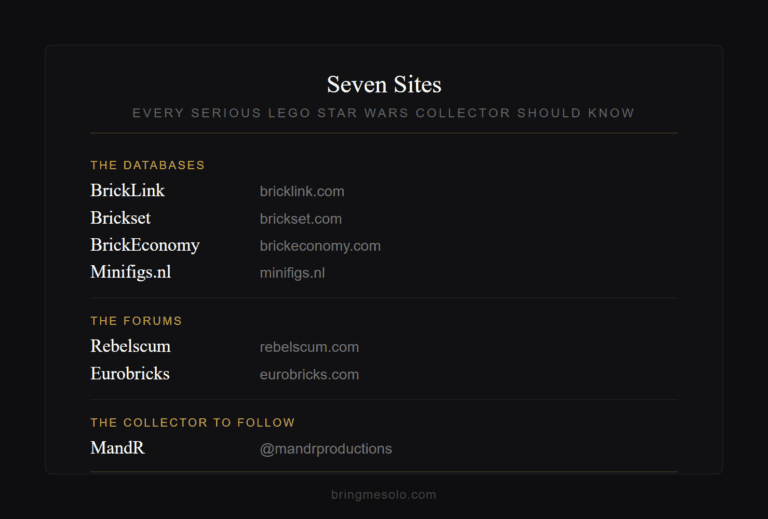
BrickEconomy is the first stop. It aggregates transaction data and presents it clearly — price history charts, trend lines, comparisons against retail. For most sets, particularly retail releases and retired sets with active secondary markets, BrickEconomy gives you a solid number with actual data behind it. It is not perfect for rare promotional items, where sample sizes are small and a single unusual transaction can skew the data, but for the mainstream catalog it is the most useful single source.
WorthPoint is worth checking when BrickEconomy comes up short — it covers a wider range of items including some promotional pieces that never appear in the standard databases. The caveat is that the values can be all over the place. A search for a single item can return prices ranging from $100 to $600 with no clear trend based on the transaction dates, which makes it difficult to derive a meaningful number. Use it as a secondary reference to confirm a ballpark, not to establish a value.
eBay and BrickLink are the ground truth. Both show actual completed transactions — what real buyers paid for real items — as well as current asking prices, which give you a sense of live market supply and what sellers currently think something is worth. For anything unusual, rare, or promotional, sold listings are more reliable than any aggregated price guide, because the guides are only as good as the transactions feeding them. Weight sold listings more heavily than active listings — asking prices tell you what sellers hope to get, not what buyers are actually paying.
One important note on eBay in particular: fakes exist, and they are getting better. This is one of the reasons detailed firsthand documentation matters — knowing what the seal sticker orientation should be, what inserts came in the box, what the packaging materials look like, and what condition a genuine example typically shows up in all help establish provenance and identify items that do not add up. When you are buying a rare item, look for sellers who can provide enough supporting materials — original box, inserts, intact seal — to help verify authenticity. The more complete the provenance, the harder it is to fake convincingly. When researching values, look at clusters of transactions from established sellers with verified feedback rather than single data points, and be skeptical of anything priced significantly below comparable sales.
Valuing Your Collection for Insurance
If you are building a collection of any significant size, insurance is worth thinking about seriously. Standard homeowners and renters policies typically cover personal property at actual cash value — depreciated replacement cost — which is not how collectibles work. A sealed 2007 Millennium Falcon that originally retailed for $499.99 is worth considerably more than $499.99 today. You need a policy that covers collectibles at current market value, not original retail.
For documentation purposes, BrickEconomy is the most defensible source for standard sets — it is transparent, data-driven, and can be referenced directly. For promotional items and rare pieces without BrickEconomy coverage, a combination of recent sold listings from eBay and BrickLink, with screenshots saved and dated, provides reasonable documentation. The goal is to be able to demonstrate to an insurer what you paid or what the item would cost to replace.
This collection tracks values periodically using BrickEconomy as the primary reference source. It is the most practical approach for maintaining current valuations across a collection of more than 1,100 items.
A Note for Collectors on a Budget
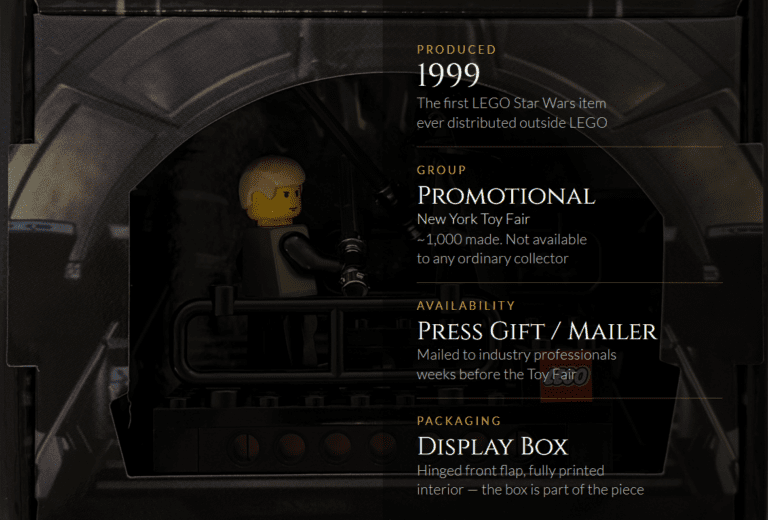
The honest truth about collecting LEGO Star Wars promotional items at the level documented on this site is that it is expensive. The 1999 Toy Fair Diorama, the SDCC exclusives, the employee Christmas gifts — these items cost serious money and they do not get cheaper over time. If budget is a real constraint, chasing rare promotional items is a game that will frustrate more than it rewards.
That does not mean collecting is out of reach. A few approaches that make sense for a collector working with a limited budget:
Buy current sets at retail. A new LEGO Star Wars set will almost never be cheaper than it is at launch. Sets retire, supply ends, and secondary market prices rise. If you buy at retail and hold, time works in your favor. When you open a set to build, keep everything — the box, the instructions, the parts bags, all of it. Open the box carefully, in a way that does not damage it any more than necessary. A complete opened set with all original materials intact is worth meaningfully more than one where the box is destroyed and the bags are thrown away.
Focus on a specific subset. The UCS line, the Microfighters, the seasonal sets, the Helmet Collection, the Starship mini-models — each is a coherent collecting goal that does not require owning everything. Completeness within a defined scope is more satisfying and more achievable than trying to own everything and falling perpetually short.
Buy used sets and complete them over time. A complete used set — original box, instructions, all parts, minifigures — is worth meaningfully more than the sum of its parts purchased separately, but the individual pieces can be sourced gradually through BrickLink at relatively low cost. Buying an incomplete used set cheaply and completing it part by part is a legitimate collecting strategy that takes patience but works.
Accept that some things are out of reach. Even serious collectors with serious budgets have a tier they do not chase. The real gold and precious metal LEGO minifigures — items like the solid gold C-3PO, which may be worth hundreds of thousands of dollars — exist in a category where the price is so disconnected from any normal collecting frame of reference that most collectors, including this one, simply do not look for them. Not looking is its own form of discipline. You do not need to own everything to be a serious collector. You need to know what you are collecting and why.
Value data referenced in individual articles on this site is sourced from BrickEconomy and updated periodically. For questions about specific items or valuation methodology, contact The Collector.