The Taxonomy of a Collection: Classifying the Unclassifiable
Every item in this collection has a precise address in a taxonomy. Here is how that taxonomy works — and why it matters.
BringMeSolo uses four classification schemes to describe every item in the LEGO Star Wars universe. This article explains what each one is, how the categories were designed, and why the choices were made the way they were.
Most LEGO databases treat classification as an afterthought. A set has a year, a theme, and a name. Maybe a piece count. That is enough to find something if you already know what you are looking for. It is not enough to understand a collection.
BringMeSolo documents over 1,100 LEGO Star Wars items — sets, promotional exclusives, event items, licensed gear, master builder statues, press mailers, contest prizes, and things that do not fit neatly into any of those descriptions. Describing that range requires something more precise than a single tag. It requires a taxonomy — a structured set of classification schemes that can be applied consistently across every item in the collection, from a standard retail polybag to a one-of-three hand-built Yoda statue that has never publicly appeared in collector hands.
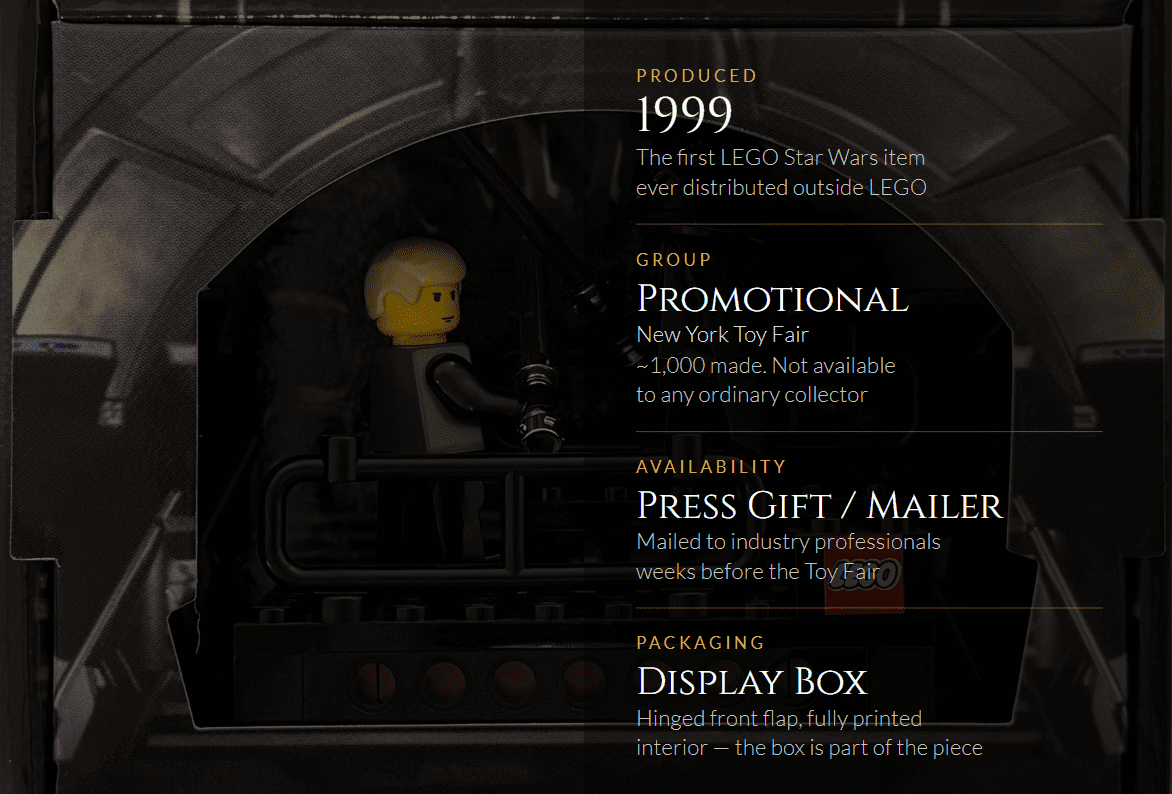
The taxonomy used on this site has four dimensions: Group, Availability, Packaging, and Produced. Each one answers a different question about an item. Together they give every item in the collection a precise, unambiguous address.
This article explains each dimension in full — what it covers, how it was designed, and where the edge cases are.
The Design Principles
Before getting into the individual dimensions, it is worth explaining the design philosophy behind the taxonomy as a whole. Two principles drove every decision.
The first is mutual exclusivity and collective exhaustiveness — commonly abbreviated MECE. Every item should fit into exactly one value per dimension. Not two. Not zero. One. This sounds simple but it has real consequences. It means you cannot have both a “Box” category and a “Tuck-Top Box” category and apply them both to the same item — one has to subsume the other, or they need to be defined precisely enough that they never overlap. It means every item, no matter how unusual, must fit somewhere. And it means the taxonomy cannot grow indefinitely by adding a new category for every edge case — that approach produces a list of 200 packaging types where half of them apply to one item each, which is useless for navigation and comparison.
The second principle is answering a single question per dimension. Group answers: what kind of thing is this? Availability answers: how was this distributed? Packaging answers: what was it packaged in? Produced answers: when was it made? Each dimension is independent. Knowing an item’s Group tells you nothing about its Availability, and vice versa. That independence is what makes the taxonomy useful — you can filter by any dimension or combination of dimensions and get meaningful results.
A Note on Promotional vs Set
Before getting into the dimensions themselves, one classification decision deserves its own explanation because it is the one that most distinguishes this taxonomy from others: the line between Promotional and Set.
Most LEGO databases treat everything with a set number as a set and everything without one as promotional. This site draws the line differently — on scarcity and access, not administrative categorization.
A Promotional item on BringMeSolo is one where scarcity, access barriers, or both made the item genuinely difficult for an average motivated collector to obtain at the time of release. The defining question is not how the item was technically distributed — it is whether essentially anyone could have gotten one. An SDCC exclusive with a 1,500-unit print run that required a badge, a line, and knowing it existed is a fundamentally different object from a gift-with-purchase polybag that LEGO produced in the hundreds of thousands and gave away at any store worldwide with a qualifying purchase. Both may have been “free.” Only one is Promotional.
Production quantity is the strongest signal — but not the only one. Access barriers matter too. The 1999 Chrome Gold C-3PO, produced in a run of 10,000 and inserted randomly into sets, is Promotional. Not because 10,000 is an inherently small number, but because obtaining one required either extraordinary luck at the time of release or significant money on the secondary market afterward. A 25th Anniversary set produced in what were almost certainly tens of thousands of units and available to any LEGO VIP member who wanted one is a Set — the access barrier was trivial and supply was sufficient to meet demand.
There is no hard numerical threshold. The judgment is holistic: could an average motivated collector have reasonably obtained this at the time, without special access, insider knowledge, or significant luck? If yes — it is a Set, regardless of how it was distributed. If no — it is Promotional.
This matters for how you use the site. A standard gift-with-purchase polybag that LEGO produced en masse appears under Group: Set with Availability: Gift with Purchase. It belongs in the catalog, but it is not a rare item and the taxonomy does not pretend otherwise. The same Availability type applied to the Times Square Yoda — 1,000 made, available only if you were physically present at a specific Toys R Us on one of three days in May 2013 — produces a very different item, and its Group classification reflects that.
Produced
The simplest dimension. Produced is the year the item was manufactured or first released — a four-digit year from 1999 to the present. No edge cases worth discussing. The year goes here.
One item on the site — the 1999 and 2000 LEGO Star Wars Mindstorms sets — carries two Produced values because the two sets in that article span both years. This is the only exception to the one-value-per-dimension rule and it reflects a deliberate choice to document those two sets together rather than separately.
Group
Group answers the question: what kind of thing is this? It is a two-level hierarchy — a top-level category and a subgroup — and it is the most structurally complex of the four dimensions.
The top-level categories are:
- Set — commercially produced LEGO building sets with official set numbers
- Promotional — items produced for a specific event, retailer, or distribution campaign outside the standard retail catalog, where scarcity or access barriers made them genuinely difficult to obtain
- Gear — licensed merchandise and non-building LEGO Star Wars products
- Co-Pack — co-packaged bundles, where two or more items are packaged and distributed together as a single unit
- Make & Take — build-it-yourself activity items given to participants at an in-store or event build, classified by the venue where the build took place
- Book / Magazine — printed publications
The subgroup provides the next level of precision. For Set, subgroups identify the product line: Standard, Ultimate Collector Series, Microfighters, BrickHeadz, Seasonal, Minifig Packs, Technic, Mindstorms, and so on. These map directly to LEGO’s own product line naming conventions where those conventions exist and are meaningful to collectors.
For Promotional, the subgroup identifies the specific event or retailer: San Diego Comic Con, Star Wars Celebration, New York Comic Con, New York Toy Fair, Fan Expo, Toys R Us, Target, LEGO Store, LEGO Club, GameStop, and others. This is where the taxonomy earns its keep for serious collectors — being able to browse every item distributed at Star Wars Celebration, or every Toys R Us exclusive, in a single filtered view is genuinely useful and not something most databases provide.
One subgroup worth noting: Unknown Store. This covers promotional items where the distribution channel is known to have been a retailer or physical venue but the specific identity is unconfirmed. The 2009 Darth Vader Store Display Maxi-Figure lives here — it was clearly a store display item, but which store or stores carried it is undocumented. Unknown Store is preferable to either leaving the subgroup blank or fabricating a specific attribution. Precision includes knowing the limits of what is known.
For Co-Pack, the subgroup captures whether the bundle adds anything to its contents: Standard is a straight pairing of items that were also sold separately, while With Bonus is a bundle built around an exclusive piece you could not get on its own. The distinction matters because a With Bonus co-pack is often the only way to obtain that bonus item, which changes how a collector values the package as a whole rather than as the sum of its parts.
For Make & Take, the subgroup records where the build happened — Barnes & Noble, LEGO Store, Target, Toys R Us, Star Wars Celebration, or Other Store when the venue doesn’t warrant its own entry. These are the small models assembled on the spot at an in-store or event activity and carried home, so the venue is the most useful thing to know about them. Make & Take is also an Availability type, and the two are not redundant: the Group subgroup answers where it was built, while Availability answers how it reached its owner.
Availability
Availability answers the question: how was this item distributed? Not what it is, not what it looks like — how did it reach the people who received it?
This dimension is deliberately independent from Group. A San Diego Comic Con exclusive (Group: Promotional > San Diego Comic Con) might have been distributed as a standard event item available to all attendees — or it might have been distributed only to press contacts at a private party. Those are different Availability values. Keeping the two dimensions separate allows both questions to be answered precisely rather than conflating them.
The Availability types currently in use:
- Bonus Item — included as an extra alongside a primary purchase, not the main promoted item
- Club Mailer — mailed directly to members of an official LEGO club or fan club program
- Contest Prize — awarded to winners of a formal contest or sweepstakes with an entry and draw process
- Customer Gift — given to customers as a goodwill gift, not tied to a specific purchase or promotion
- Employee Gift — distributed to LEGO employees internally
- Event — distributed at a convention or event to general attendees
- Game Prize — won on the spot by completing a game or activity at an event booth
- Gift with Publication — physically bundled with a publication at retail
- Gift with Purchase — free item given at retail with a qualifying purchase
- LEGO Exclusive — sold only through LEGO brand stores, LEGO.com, or the LEGO Shop at Home catalog
- LEGOLAND Exclusive — available only at LEGOLAND theme parks
- Magazine Gift — cover-mounted or insert gift with a magazine specifically
- Make & Take — a build-it-yourself item given to participants at an in-store or event activity
- None — no defined distribution channel
- Press Gift / Mailer — sent directly to journalists, media contacts, or industry professionals
- Retail — available through standard general retail channels
- Store Display — used as an in-store or event display model
A few distinctions that took deliberate thought:
Event vs Press Gift / Mailer. Both involve an event, but they are fundamentally different distributions. Event means the item was available to general attendees at the event itself. Press Gift / Mailer means it went specifically to media or industry contacts — often before the event, as an invitation or teaser. The 2013 NY Toy Fair Yoda Diorama is Press Gift / Mailer, not Event, because it was given in a private Collector Party gift bag to credentialed guests, not distributed generally on the Toy Fair floor.
Contest Prize vs Game Prize. Both are prizes, but the mechanism is different. Contest Prize involves a formal entry process — you submit something, a draw or judging happens later, winners are notified. Game Prize is immediate — you play something at an event booth and you win or you don’t. The distinction matters because it tells you something about the distribution: a Contest Prize can go anywhere in the world if entries are mailed or submitted online, while a Game Prize almost certainly went to someone physically present at a specific event on a specific day.
Gift with Purchase vs Bonus Item. A Gift with Purchase is a deliberate promotional mechanic — spend a qualifying amount and receive this item. A Bonus Item is something included alongside a purchase without being the promoted incentive. The difference is subtle but real, and it affects how you think about the item’s intended audience and production quantity.
Packaging
Packaging answers the question: what was this item packaged in? It is the most technically detailed of the four dimensions and the one that required the most deliberate constraint to keep useful.
The challenge with packaging is that LEGO has used an enormous variety of formats across 25+ years of Star Wars releases. A naive approach would create a new category for every distinct variant — separate types for every subtle box opening mechanism, every seal configuration, every material combination. That approach produces a taxonomy that is accurate in a narrow sense but useless in practice, because categories that apply to one or two items are not categories — they are descriptions.
The approach here was to define types at the level of meaningful collector distinction. Two packaging formats belong in the same category if knowing which one you have does not tell you something materially different about the item as a collector. Two formats belong in different categories if the distinction is something a serious collector would actually care about — either for display, storage, authentication, or understanding the item’s context.
The Packaging types currently in use:
- Blister Card — cardstock backing with a formed plastic blister heat-sealed to the front
- Box — standard rigid cardboard box that does not fit a more specific box subtype; the most common LEGO retail box format
- Display Box — box designed primarily for display, with presentation features such as windows, hinged flaps, or premium construction; the box itself is part of the experience
- Display Cube — clear acrylic cube enclosure used to display a built scene or figure
- Flap Box — a standard box with an additional front-hinged flap; the flap does not provide access to the contents but carries additional printed information
- Foil Pack — sealed metallic foil bag
- Glued Model — pre-assembled model not intended to be taken apart; covers everything from hand-sized figures to life-size master builder statues
- Header Tab Box — small box with a tab at the top containing holes for hanging on a peg hook
- Lift-Off Lid Box — two-piece box where the top lifts straight off
- Loose Parts — unassembled parts with no packaging
- Magnetic Closure Box — premium box that closes with embedded magnets
- Mailer Box — outer shipping box used to contain and protect the item inside during distribution
- Metal Canister — cylindrical, square, or shaped metal tin
- None — no packaging; the item itself is the complete object with nothing containing it
- Paper Bag — plain or printed paper bag
- Plastic Bucket — hard plastic bucket with handle and lid; the only LEGO Star Wars set ever packaged this way is the 2000 Podracing Bucket
- Plastic Case — rigid molded plastic case enclosing the item fully
- Plastic Clamshell — two-piece hinged rigid plastic case that opens like a clam
- Polybag — standard LEGO sealed polyethylene bag with printed header or backing card
- Resealable Bag — bag with a zip-lock or resealable adhesive closure
- Soft Bag — non-rigid clear or printed soft plastic bag; distinct from a Polybag in the material it is constructed from — polybags are made from stiff, crinkly polyethylene, while soft bags are not
- Tin Can — cylindrical metal tin
- Tuck-Flap Box — box where the lid has a front flap with two tabs that fold back into the sides to open and close the box
- Tuck-Top Box — standard tuck-top closure where the top folds in with a single tuck strip
A few distinctions that required the most thought:
The box subtypes. Box, Tuck-Top Box, Tuck-Flap Box, Flap Box, Lift-Off Lid Box, Display Box, and Mailer Box are all boxes. The question was whether to have one Box category or many. The answer was many — but only where the distinction is meaningful. A Tuck-Top Box and a Tuck-Flap Box feel and open completely differently; a collector handling one versus the other would notice immediately. A Display Box is not a box in the functional sense at all — it is a presentation object. A Mailer Box is a shipping container, not the item’s actual packaging. These distinctions belong in the taxonomy. The difference between two boxes that both open from the top via a tuck mechanism is not a meaningful collector distinction — they both get Tuck-Top Box.
Glued Model. This type covers a wide range — from partially glued figures the size of a minifigure to life-size master builder statues weighing hundreds of pounds. The unifying characteristic is that the item is pre-assembled and not intended to be disassembled. Scale does not change that fundamental nature. A separate category for large-format glued models would apply to fewer than ten items in the entire collection and would add no navigational value. Glued Model covers all of them.
Polybag vs Soft Bag. Both are plastic bags. The distinction is in the material each is constructed from. A Polybag is a standard LEGO production format — stiff, crinkly polyethylene with a printed header or backing card, produced in the same way LEGO produces retail polybag sets. A Soft Bag is anything else — a non-rigid bag without that standard construction. The Times Square Yoda minifigure (sw0465a) came in a small clear soft plastic bag with a separate printed card insert, not a standard polybag header. It is a Soft Bag. The distinction matters for authentication — a genuine Times Square Yoda should have the specific card insert, not a standard polybag header.
None. Both Packaging and Availability have a None value. In Packaging, None means the item has no packaging at all — the COMCON011 Holo-Brick Archives, for example, is a complete assembled object that was never packaged in anything. In Availability, None means no defined distribution channel can be identified. These are rare but real cases and the taxonomy needs to accommodate them without forcing a false classification.
How the Dimensions Work Together
The real power of a four-dimensional taxonomy is in combination. A single dimension tells you something. Four dimensions together tell you everything about an item’s context.
Consider the 2013 NY Toy Fair Yoda Diorama. Its four values are: Produced: 2013 | Group: Promotional > New York Toy Fair | Availability: Press Gift / Mailer | Packaging: Display Cube. Each dimension adds information the others don’t provide. Produced tells you when. Group tells you it was a Toy Fair item specifically. Availability tells you it went to media and industry contacts, not general Toy Fair attendees. Packaging tells you it came in a premium acrylic cube. No single dimension tells you the whole story. Together they describe the item precisely enough that you could pick it out of a room full of similar items without knowing its name.
That precision is what makes the taxonomy useful for a collection of this scope. With over 1,100 items spanning 25 years of LEGO Star Wars — standard retail sets, convention exclusives, contest prizes, press mailers, store displays, and things that exist in quantities of three — a taxonomy that treats everything the same way is not a taxonomy. It is a list.
This is not a list.
The taxonomy described in this article is applied to every item documented on BringMeSolo. It is a living system — new types will be added as items surface that require them, and existing definitions will be refined when the edges need sharper boundaries. If you encounter an item whose classification seems wrong or unclear, the comments are the right place to raise it.